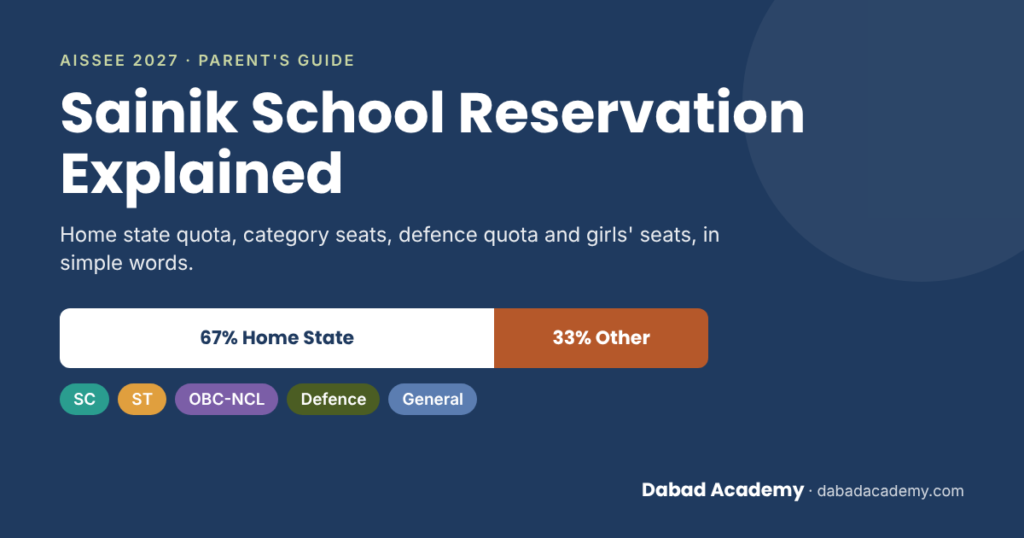
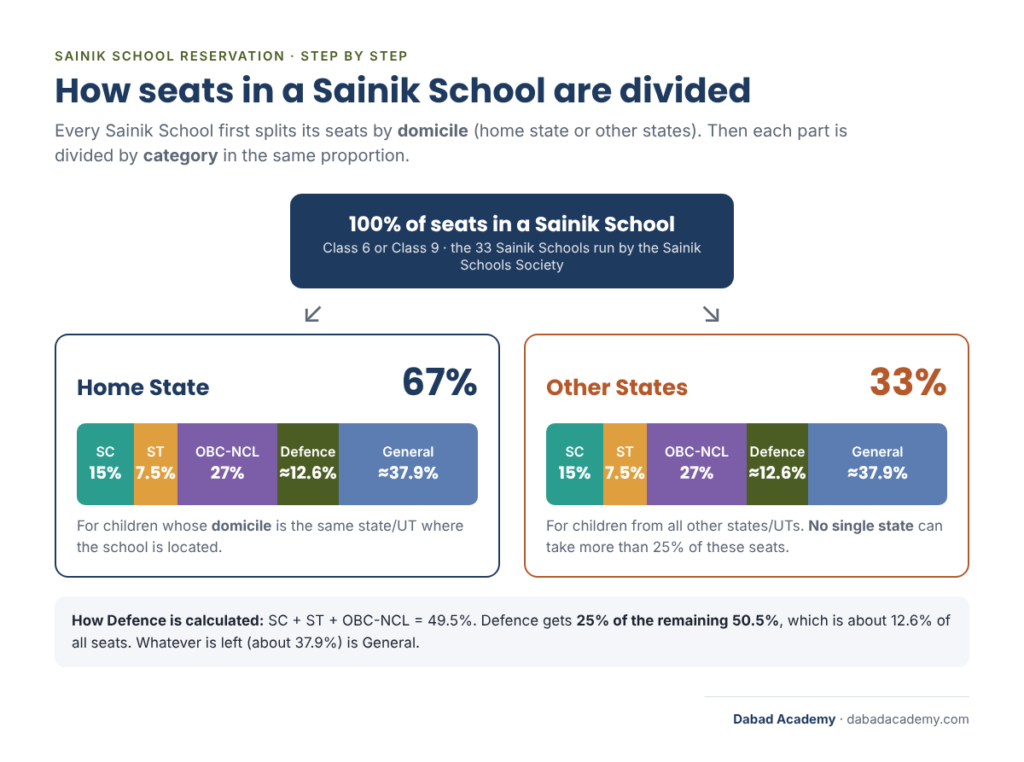
You have filled the AISSEE form or you are about to, and one question keeps coming back: how many seats can my child actually compete for? The answer lies in understanding Sainik School reservation. In the 33 old Sainik Schools run by the Sainik Schools Society, 67% of seats go to home state children and 33% to children from other states and each part is then further divided among SC, ST, OBC-NCL, Defence and General categories. All rules explained here are taken from the official AISSEE Information Bulletin published by the National Testing Agency (NTA). For best Sainik School Coaching classes, connect with Dabad Academy here.
Key takeaways: Reservation in Sainik Schools
- 67% Home State, 33% Other States in the 33 Sainik Schools run by the Sainik Schools Society.
- Inside each part: SC 15%, ST 7.5%, OBC-NCL 27%, and Defence gets 25% of the remaining 50.5% (about 12.6% of all seats).
- Girls in Class 6: 10% of seats or 10 seats, whichever is higher. Class 9: open to girls where vacancies exist.
- New Sainik Schools have no domicile or category reservation: at least 40% seats from the All-India merit list, up to 60% for their own students.
- SC/ST have no minimum qualifying marks for the older Sainik Schools; everyone needs 25% per subject and 40% overall for new Sainik Schools.
- Only the Central OBC list counts. State-list-only OBC families should choose General.
Have a question we haven’t answered? Our mentors reply in the Dabad Academy parents’ WhatsApp group.
What is reservation in Sainik Schools?
Reservation in Sainik Schools means a fixed share of seats is kept aside for specific groups of children: those from the school’s own state, SC, ST and OBC-NCL children, and children of defence personnel. Your child competes only with children in the same group, not with every candidate in India.
Two kinds of Sainik Schools follow different rules, so keep this in mind from the start:
- Old Sainik Schools: the 33 schools run by the Sainik Schools Society under the Ministry of Defence. Full domicile and category reservation applies.
- New Sainik Schools: schools approved by the Ministry of Defence to run in partnership mode with states, trusts or private schools. Their Sainik School stream has no domicile or category reservation (one exception, explained below). See our complete list of new Sainik Schools.
How is your child’s home state decided?
Home state depends only on domicile, the state your child legally belongs to as shown on a domicile certificate. It does not depend on where you work, where your child studies, or where you live on rent.
The bulletin gives a simple example. Sainik School Balachadi is in Gujarat (near Jamnagar). A child with Gujarat domicile who chooses Balachadi is Home State. A child with Haryana domicile who chooses Balachadi is Other States. If your child’s own domicile certificate is not available, the NTA postal for Sainik School online application allows a parent’s domicile certificate to be uploaded instead.
Other state quota 25% cap rule in Sainik Schools
Within the 33% Other States bucket, no single state or union territory can get more than 25% of the seats in any category. The bulletin’s own example: if a category has 10 Other States seats, one state can get at most 3 of them.
Why does this matter? It stops one large state from filling every outside seat, so children from smaller states also get a fair chance.
Category-wise reservation: SC, ST, OBC-NCL, Defence and General
Inside each bucket (Home State and Other States), seats are divided by category: SC 15%, ST 7.5%, OBC-NCL 27%. These three add up to 49.5%. Of the remaining 50.5%, 25% goes to Defence. Whatever is left after that is General.
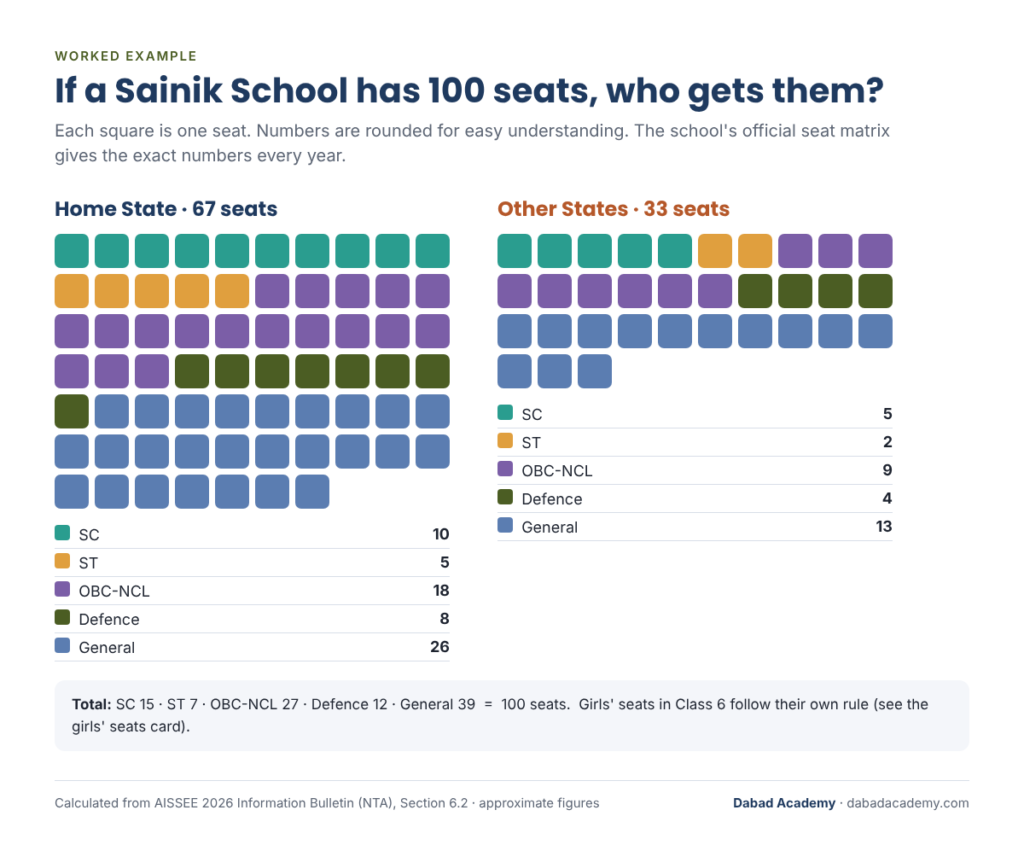
| Category | Home State (67) | Other States (33) | Total |
| SC | 10 | 5 | 15 |
| ST | 5 | 2 | 7 |
| OBC-NCL | 18 | 9 | 27 |
| Defence | 8 | 4 | 12 |
| General | 26 | 13 | 39 |
| Total | 67 | 33 | 100 |
OBC-NCL: only the Central list counts in AISSEE exam
OBC reservation in AISSEE is only for castes in the Central OBC list published by the National Commission for Backward Classes (NCBC), as on the first day of the month in which the online form opens. The family must also be in the non-creamy layer (meet the income rules).
If your caste appears only in your state’s OBC list, the bulletin is clear: choose General. The OBC-NCL certificate must follow the format in the bulletin (Appendix VII), along with the declaration in Appendix VIII.
A reserved-category child with high marks takes a General seat in AISSEE
This rule surprises many parents, and it is good news. If an SC, ST or OBC-NCL child scores high enough to make the General merit list, the child is admitted against a General seat. The reserved seat then goes to the next child of that category. So a strong reserved-category student never “uses up” a reserved seat.
Real schools rarely have exactly 100 seats, and exact numbers change every year. Always check the official seat matrix. You can find last year’s figures in our pages for Class 6 boys, Class 9 boys, Class 6 girls and Class 9 girls.
Want to see where your child stands right now? Free practice tests are in the Sainik School Cadet app, and our mentors share each new seat matrix in the parents’ WhatsApp group the day it releases.
How many seats are reserved for girls in Sainik Schools?
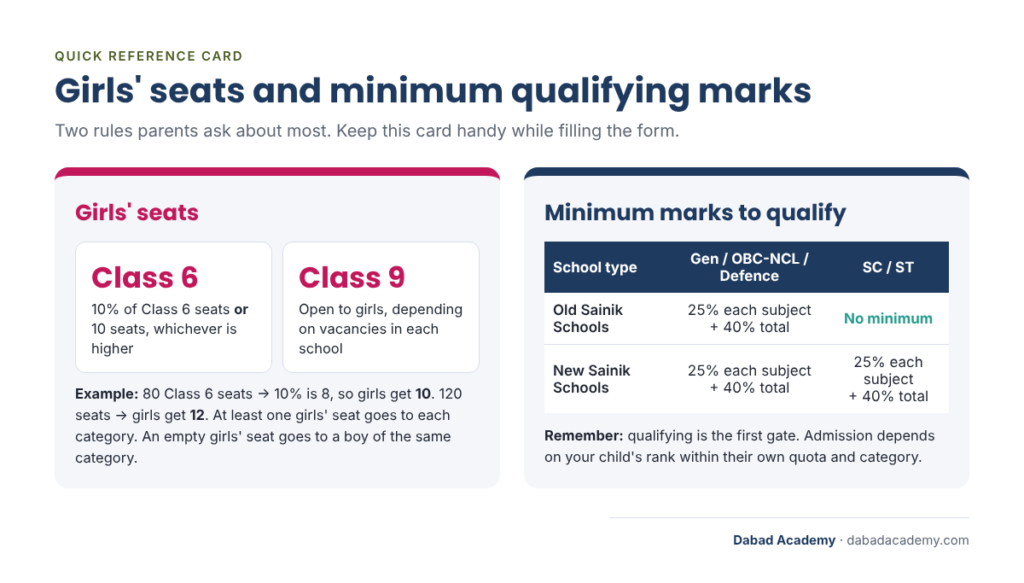
In Class 6, every Sainik School reserves 10% of its Class 6 seats or 10 seats, whichever is higher, for girls. At least one girls’ seat goes to each category. In Class 9, girls are admitted where vacancies exist, so availability differs from school to school.
A quick example: a school with 80 Class 6 seats would reserve 10 seats for girls (because 10% of 80 is only 8). A school with 120 seats would reserve 12. If a girls’ seat stays empty, it goes to a boy of the same category.
Is there reservation in the new Sainik Schools?
No domicile or category reservation applies in the Sainik School stream of the approved new Sainik Schools. Instead, at least 40% of seats are filled from the All-India AISSEE merit list, and up to 60% go to children already studying in that school, ranked on a school-wise merit list.
Minimum qualifying marks by category
To be considered for admission at all, a child must first qualify AISSEE. For the old Sainik Schools, General, OBC-NCL and Defence candidates need 25% in each subject and 40% overall, while SC and ST candidates have no minimum. For the new Sainik Schools, every candidate, including SC and ST, needs 25% per subject and 40% overall.
| School type | General / OBC-NCL / Defence | SC / ST |
| Old Sainik Schools (33) | 25% in each subject + 40% aggregate | No minimum |
| New Sainik Schools | 25% in each subject + 40% aggregate | 25% in each subject + 40% aggregate |
Source: AISSEE 2026 Information Bulletin (NTA)
Qualifying is only the first gate. Admission depends on your child’s rank within the quota and category, so aim well above the minimum. For the full list, see our documents required for Sainik School admission.
Reservation in Sainik Schools: FAQ’s
In the 33 Sainik Schools run by the Sainik Schools Society, 67% of seats are reserved for children whose domicile is the same state or union territory where the school is located. The remaining 33% go to children from other states and union territories. Category reservation for SC, ST, OBC-NCL and Defence is then applied inside each of these two parts.
Home state depends only on domicile. If your child’s state of domicile is the same as the state of the chosen Sainik School, your child is in the Home State list. If it is different, your child is in the Other States list. You upload a domicile certificate with the AISSEE form; if the child’s certificate is not available, a parent’s domicile certificate can be uploaded.
After SC, ST and OBC-NCL seats (49.5% together), 25% of the remaining 50.5% of seats are reserved for wards of serving personnel and ex-servicemen of the Army, Navy and Air Force. That is about 12.6% of all seats, and it applies separately in the Home State and Other States quotas, as per the AISSEE Information Bulletin.
In Class 6, girls get 10% of the school’s Class 6 seats or 10 seats, whichever is higher, with at least one girls’ seat for each category. In Class 9, girls are admitted where vacancies exist. If a girls’ seat stays empty, it goes to a boy of the same category. Check the girls’ seat matrix of your chosen school every year.
No category or domicile reservation applies to the Sainik School stream of approved new Sainik Schools, except Kranthiveera Sangolli Rayanna Sainik School, Belagavi. At least 40% of their seats are filled from the All India AISSEE merit list and up to 60% go to children already studying in that school, ranked on a school-wise merit list.
No. Only castes in the Central OBC list published by the National Commission for Backward Classes count, and the family must be in the non-creamy layer. If your child’s caste is only in your state’s OBC list, choose the General category in the AISSEE form. The OBC-NCL certificate must follow the format given in the bulletin.
For the 33 Sainik Schools run by the Sainik Schools Society, SC and ST candidates have no minimum qualifying marks. All other candidates need 25% in each subject and 40% overall. For approved new Sainik Schools, every candidate, including SC and ST, needs 25% in each subject and 40% overall.
The Editorial Team at Dabad Academy has guided parents through Sainik School, RMS and RIMC admissions since 2016. Every fact is checked against official NTA notices.